EN
EN
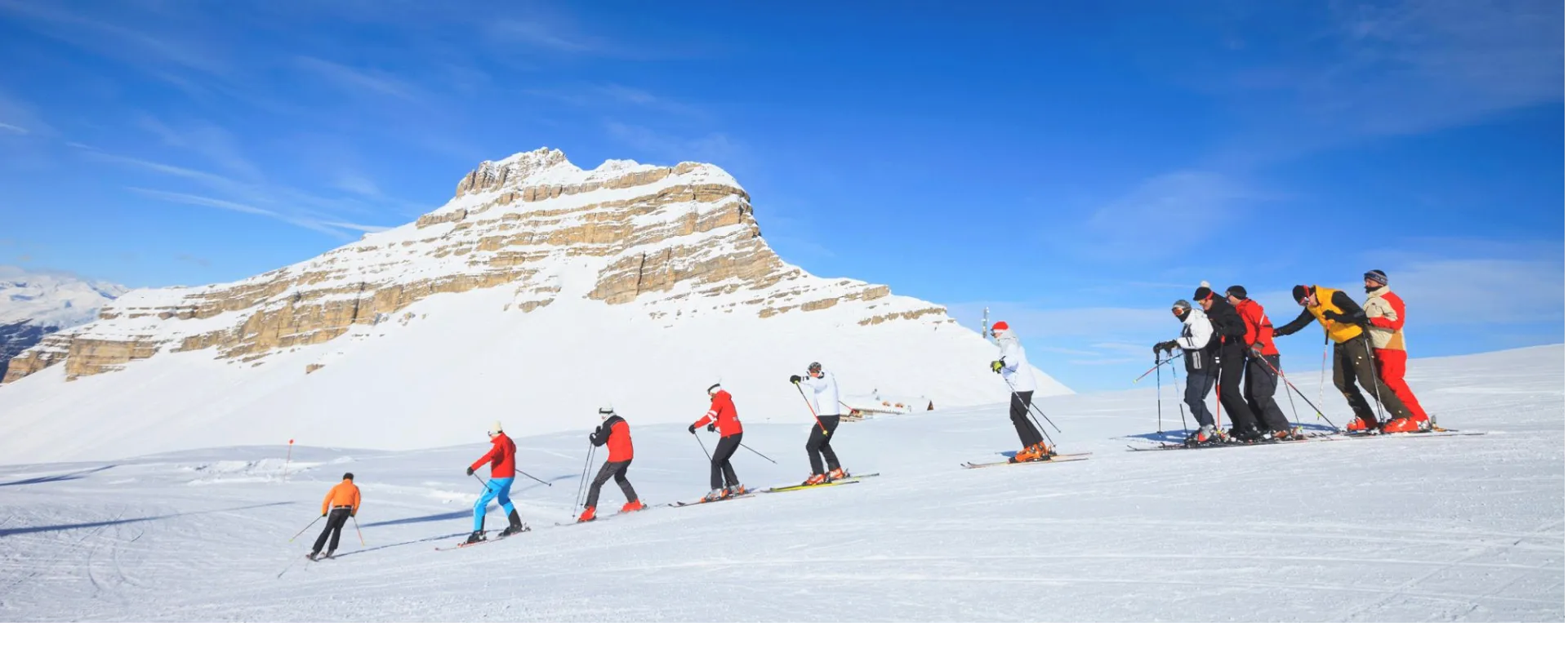
Booking ski lessons is one of the most impactful decisions you’ll make for your holiday, but it’s not always obvious how to go about it. Group or private? Morning or afternoon? Full week or a couple of days? The options vary by resort, and the right choice depends on your level, your goals, and who you’re travelling with. This guide covers the practical steps - from choosing the format to timing your booking - so you can make the decision with confidence. For the detail on what actually happens once you’re in a lesson, our guide to what happens in a ski lesson walks through levels, progression, and how instructors teach. And if you want to compare resorts with strong ski schools, our best ski schools and resorts for lessons list is a useful starting point.
Group lessons are the default for most skiers, and for good reason. You’re placed with others at your level, follow a structured programme across the week, and the social element adds something that’s hard to replicate alone. Standard group sizes run between six and ten people, with sessions lasting two to three hours, usually in the morning.
Private lessons suit different situations. If you’re a nervous first-timer and want one-to-one attention, a private lesson removes the pressure of keeping pace with a group. If you’re an intermediate skier who wants to work on a specific technique, the focused format is more efficient. And if you’re travelling as a family or a small group of friends, a private session lets the instructor tailor the lesson to all of you at once.
A practical approach for many skiers is to combine both: group lessons for the structured programme and one or two private sessions to address something specific. That way you get the social rhythm of a group and the precision of individual instruction without committing fully to either.
For first-timers, a full week of morning lessons is the most effective format. The daily repetition builds muscle memory, and having the same instructor across the week means you pick up where you left off rather than re-establishing your level each day. Most beginners see the biggest improvements between day three and day five.
If you’ve skied before and are comfortable on blue runs, three to four days of lessons is often enough. You’ll have time to work on technique in the mornings and then apply what you’ve learnt on your own in the afternoons. Experienced skiers booking a private session may only need one or two days focused on a particular skill.
It’s worth noting that ski muscles tire quickly, especially in the first few days. A lesson schedule that leaves afternoons free gives your body time to recover and lets you enjoy the rest of the resort - the mountain, the village, the food - without pushing through fatigue.
Morning lessons are the standard option and usually run from around 9:00 or 9:30 until midday. Slopes tend to be freshly groomed and less crowded early on, and instructors are working with the best snow conditions of the day. For beginners, mornings are when you’re freshest physically and mentally, which helps new skills stick.
Afternoon sessions are less common for groups but widely available for private bookings. The advantage of an afternoon lesson is that the slopes are quieter - most group lessons and ski school classes have finished by lunchtime. If you prefer a relaxed start to the day or find mornings too cold, an afternoon private lesson can be a good fit.
Some ski schools also run lunchtime or late-morning slots, which work well if you want to warm up with a couple of free runs before your lesson starts. Availability varies by resort, so it’s worth checking what’s on offer when you book.
Not all ski schools are the same, and the differences matter more than you might expect. National schools like the ESF in France or the Austrian state ski schools are large operations with deep local knowledge and a wide range of instructors. Independent schools, particularly British-run ones, tend to have smaller groups, teach exclusively in English, and focus on a teaching style that UK skiers often find more relatable.
The key things to consider are language, group size, and teaching approach. If clear English instruction matters to you, look for schools that guarantee English-speaking instructors rather than ones where you need to request it. If small groups are a priority, independent schools are often the stronger choice. And if you’re looking for something specialist - off-piste guiding, freestyle coaching, race technique - check whether the school runs dedicated clinics.
Your resort choice shapes your ski school options. Larger resorts like Courchevel and Méribel have multiple schools to choose from, while smaller resorts like Obergurgl or Alpbach may have just one. Both approaches can work well - it’s about finding the right match for what you want from the week.
Early booking is the single most practical piece of advice for ski lessons. Popular ski schools fill up during peak weeks - half-term, Christmas, Easter - and specific instructors for private lessons are often reserved months in advance. If you know your dates, booking your lessons at the same time as your accommodation and lift pass avoids the scramble closer to departure.
For group lessons, booking early also improves your chances of getting the right level group. Schools allocate places in order, and a full group means latecomers may be placed in a less suitable level simply because of availability.
Booking through WeSki means your lessons are co-ordinated with the rest of your holiday. Accommodation, transfers, lift passes, and lessons all align, so there’s no risk of a morning lesson clashing with a late transfer arrival or a lift pass that doesn’t start until the afternoon.
Lessons work best when they fit naturally into your daily rhythm rather than creating conflicts. Morning lessons followed by free skiing in the afternoon is the most common pattern, and it works well because it gives you structure and independence in equal measure.
If you’re travelling with others who aren’t taking lessons, timing matters. Morning lessons mean you’re free by lunchtime to ski together, eat together, or explore the resort. If some of your group are in different lesson levels, you’ll meet up at lunch regardless - lesson schedules across a resort are usually synchronised.
For families, children’s lessons and adult lessons typically run at the same time. This means parents can learn at their own level while children are in age-appropriate groups. The afternoon then becomes family time - a gentle run together, a hot chocolate stop, or simply calling it a day and heading to the pool or village.
You don’t need anything special for a ski lesson beyond the standard gear you’d wear on the slopes: ski jacket and trousers, base layers, gloves, helmet, and goggles or sunglasses. Your boots and skis should already be fitted - either hired or your own - and ready to go.
What’s worth remembering is the small stuff. Sunscreen is essential at altitude, even on cloudy days. A small snack and water are useful for mid-lesson breaks. And if your ski school has asked you to meet at a specific location, find it the day before rather than searching for it on a busy Monday morning.
Arrive at least ten minutes early on day one. The initial assessment, group placement, and introductions take time, and missing the start means playing catch-up. Most schools post meeting points and start times online or in the resort information pack - check the evening before so you know exactly where to go.
| Decision | Recommendation |
|---|---|
| Group vs private | Group for structure and social learning; private for focused goals or nervous first-timers. Combine both for the best of each. |
| Duration | Full week for first-timers. Three to four days for returning skiers. One to two private sessions for specific technique work. |
| Time of day | Mornings for the best snow and freshest energy. Afternoons for quieter slopes and a relaxed start. |
| Ski school type | British-run independents for guaranteed English and small groups. National schools for breadth and local knowledge. |
| When to book | As early as possible - especially for peak weeks. Book with your accommodation to keep everything co-ordinated. |
| Day one prep | Arrive 10 minutes early. Know the meeting point. Bring sunscreen, water, and a snack. |
Even a single lesson makes a noticeable difference, particularly for beginners. If you’re on a three or four-day trip, a private lesson on your first morning sets you up with the basics and the confidence to enjoy the rest of the trip independently. For returning skiers, one targeted private session can address the specific thing holding you back more effectively than a full week of group sessions.
Most ski schools accommodate this, though availability for private instructors can be limited during busy weeks. The easiest approach is to book a combination upfront - a few group days and a private session or two. If you decide mid-week that you want to switch, speak to the ski school office directly. They’re used to adjusting bookings and will do what they can to find you a slot.
This happens, and it’s easily resolved. If the group feels too easy or too challenging after the first session, let the instructor or the ski school office know. Moving between groups is standard practice and ski schools expect it - the initial assessment is a best guess, and sometimes it takes a run or two to find the right fit. A good ski school will move you without any fuss.
Children’s lessons run in age-appropriate groups and are typically separate from adult sessions. This means you can book lessons for yourself and your children at the same time, each in the right group. Most ski schools synchronise the schedule so everyone finishes around the same time, leaving afternoons free for family skiing. Our guide to what happens in a ski lesson covers children’s lesson structure in more detail.
Lessons can be added to your WeSki booking alongside accommodation, transfers, lift passes, and equipment hire. Adding them at the time of booking means everything is timed to fit together - your lesson schedule aligns with your transfer arrival, your lift pass covers the right days, and you don’t need to co-ordinate anything separately once you arrive.
Got a clearer picture of what you need? Use WeSki’s AI trip planner to find resorts with the lesson options and ski schools that match your priorities.

WeSki is a trading name operated by WeTrip Ltd. All the flights and flight-inclusive holidays on this website are financially protected by the ATOL scheme. When you pay you will be supplied with an ATOL Certificate. Please ask for it and check to ensure that everything you booked (flights, hotels and other services) is listed on it. Please see our booking conditions for further information or for more information about financial protection and the ATOL Certificate go to: www.caa.co.uk.
Package holidays that do not include travel by air are financially protected via ABTOT.
For the latest travel advice from the Foreign & Commonwealth Office visit www.gov.uk/foreign-travel-advice.