
EN
EN
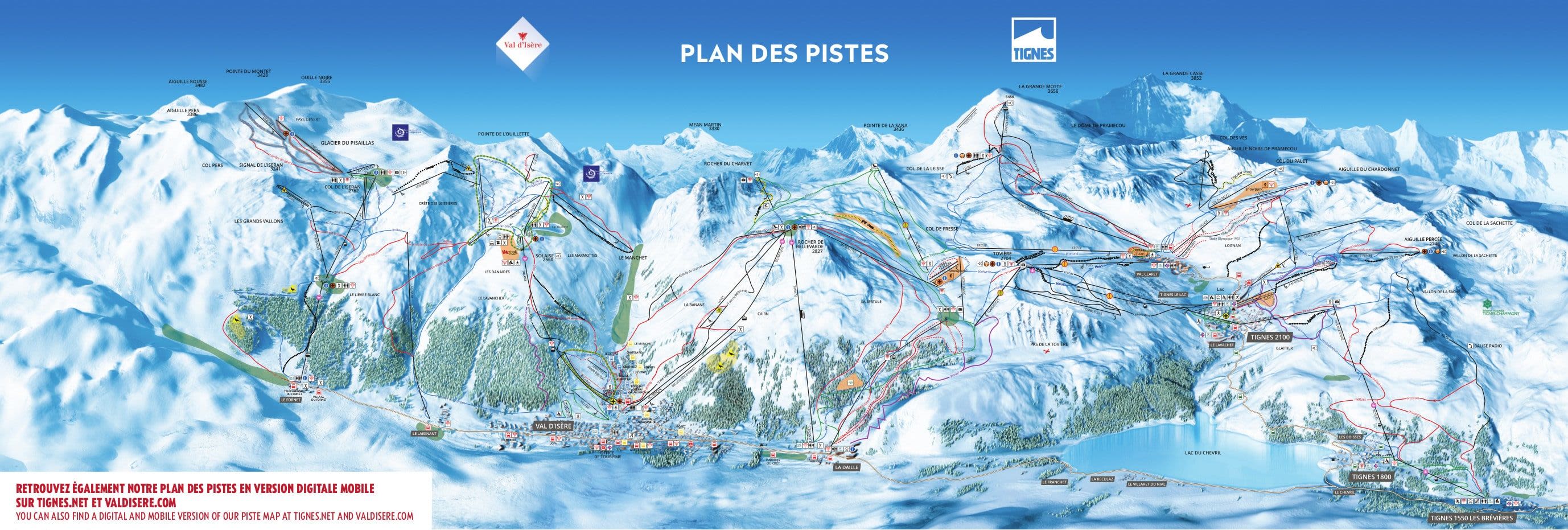
High above the Tarentaise valley, Tignes and Val d'Isère share one of the highest and most snow-sure ski areas in the French Alps, with around 300km of linked pistes. Val d'Isère is a traditional mountain village stretched along a narrow valley at the foot of the Col de l'Iseran, and it’s been a ski resort since the 1930s. Tignes is a modern, purpose-built resort set around the Lac de Tignes at 2,100m, with the Grande Motte glacier rising above it.
Whether you ski or snowboard, the terrain here rewards every level, though it's best known for big, high-altitude skiing. Beginners have dedicated learning areas in both resorts, including a sunny plateau at the top of Val d'Isère's Solaise gondola and progression zones in Tignes' villages. Intermediates can cruise wide, open blues and reds above the treeline, with long runs, big views across the Vanoise National Park, and snow that holds up well all season. For advanced skiers and riders, steep blacks such as the Olympic Face de Bellevarde and vast off-piste terrain make this one of the most celebrated advanced areas in Europe. With the Grande Motte glacier topping out at 3,456m, there's skiing here from late November to early May, one of the longest seasons in the Alps.
Both resorts have strong reputations, but they offer quite different holidays off the slopes. Val d'Isère has a traditional village centre and some of the best-known après-ski in the Alps, from the original La Folie Douce on the mountain to Dick's Tea Bar, which has kept the village dancing since 1979. Its restaurants range from Savoyard classics to Michelin-starred dining. Tignes is built around the Lac de Tignes, a natural lake that freezes over in winter, with ski-in, ski-out convenience, lively bars in Val Claret and Le Lac, and Le Lagon aquatic centre for a swim with views over the frozen water. Across both, days off the skis can be spent enjoying winter activities like snowshoeing and ice driving, or unwinding at a spa.
| Country | France |
| Region | Savoie / Tarentaise Valley, Northern Alps |
| Total piste km | 300 km |
| Altitude | 1,550 m (Tignes Les Brévières) - 3,456 m (Grande Motte glacier) |
| Linked resorts | 2 Tignes Val d'Isère |
| Lifts | 78 |
| Runs | 154 (22 green, 61 blue, 46 red, 25 black) |
| Season | Late November - early May (glacier skiing from October and into summer) |
| Ski pass name | Tignes - Val d'Isère ski pass (formerly Espace Killy) |
| Nearest airports | Chambéry (~1 hr 45 min) Lyon (~2 hr 30 min) Geneva (~3 hr) Grenoble (~2 hr 45 min) |
| Glacier skiing | Yes - Grande Motte glacier (3,456 m) above Tignes, open from October |
| WeSki services | Lessons: Tignes, Val d'Isère Transfers: both resorts (private and shared to both; scheduled to Tignes) Ski equipment hire: Tignes (main village, Les Boisses/1800, Les Brévières), Val d'Isère |
Tignes spreads across five villages at different altitudes, from Les Brévières at 1,550m to Le Lac and Val Claret at around 2,100m, with the Grande Motte glacier rising to 3,456m above them. Much of the terrain sits high above the treeline, on wide, open slopes that hold their snow well through a long season. Beginners have progression zones in Val Claret, Le Lac, and Le Lavachet, with moving carpets and short chairlifts to start on. Intermediates can cruise the long, open blues and reds of the Palafour and Tovière sectors, and up on the glacier, the undulating Génépy blue makes a long, scenic run down from altitude. The glacier has something for every level, with steeper slopes near the summit for stronger skiers. For advanced skiers, La Sache is the signature run, a long, mogul-covered black that drops from the Aiguille Percée all the way to Les Brévières, while ungroomed routes such as the Golf and Campanules add plenty of variety.
A stay in Tignes is all about being close to the snow. In the upper villages, ski-in, ski-out apartments put the slopes right on your doorstep, and Le Lac and Val Claret have the widest choice of restaurants, cafés, and shops, from fondue to fine dining. Après-ski spills out onto sunny terraces as the lifts close, and the biggest choice of bars is in Le Lac and Le Lavachet. For a quieter, more relaxed base, the wooded villages of Les Boisses and Les Brévières suit families, linked to the rest by shuttle bus and gondola. Off the slopes, the frozen Lac de Tignes is the centre of winter life, with dog sledding across the ice, skating when it's thick enough, and even ice diving beneath the surface. Le Lagon, on the lakeshore, adds a 25m pool, water slides, and a wellness area with views over the frozen water.
Val d'Isère's skiing spreads across three main sectors above a long valley village at 1,850m. Bellevarde, rising to around 2,830m, is home to the Face de Bellevarde, a steep black run that hosted the men's downhill at the 1992 Olympics and still welcomes the World Cup each December. Solaise, the resort's original ski area, has an excellent beginner area, with moving carpets on the plateau at the top of the gondola. At the far end of the valley, Le Fornet leads up towards the Col de l'Iseran, with high, scenic runs and access to the resort's summer glacier. Intermediates will find plenty to enjoy across all three, from Solaise's sunny, rolling blues and reds to long, open runs on Bellevarde and high-altitude pistes around the Col de l'Iseran. Advanced skiers have La Face itself, plus some of the area's best off-piste on Bellevarde, including the Tour du Charvet.
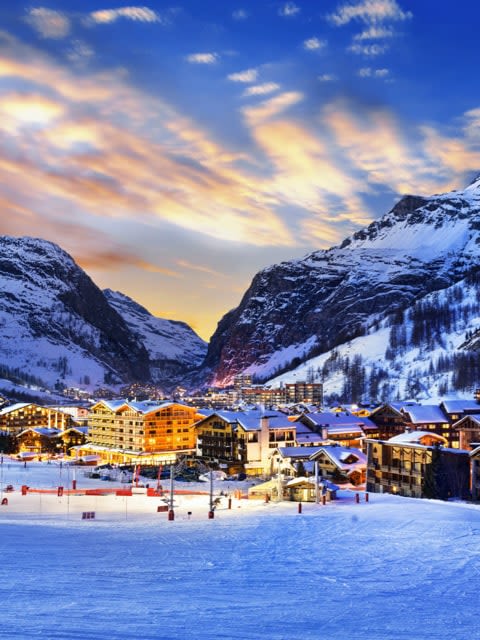
The village stretches along the valley floor, with a traditional centre at its heart and plenty of shops and cafés to explore. Accommodation ranges from ski-in, ski-out residences at the foot of the slopes to chalets and luxury hotels in the centre. Food is a highlight of any stay here, with Michelin-starred dining alongside cosy Savoyard spots and mountain restaurants serving classic Alpine dishes. Val d'Isère is also one of the best-known après-ski destinations in the Alps. The original La Folie Douce sits on the mountain above the village, and back in the centre, the party carries on into the early hours. Off the slopes, you can try guided snowshoeing, dog sledding, or paragliding, or spend a relaxed afternoon at the aquatic centre. For families, the resort holds the Famille Plus label, with a children's village and dedicated activities for young skiers.
Tignes - Val d'Isère has a reputation for big, challenging skiing, but it's also a welcoming place to learn. Both resorts have dedicated learning areas with moving carpets and gentle slopes, and there are ski schools in every village, so lessons are easy to find wherever you stay. Because the learning areas sit high, it's worth taking your first day steadily while you adjust to the altitude.
In Val d'Isère, the Solaise plateau at the top of the gondola is a lovely place to start, with three moving carpets, sunny slopes, and big mountain views. Once you're ready to move on, Solaise's gentle, rolling blues make a comfortable next step without leaving the plateau. In Tignes, progression zones in Val Claret, Le Lac, and Le Lavachet sit close to the accommodation, with moving carpets and short chairlifts. The wide, open green runs around the lake give you plenty of room to practise your turns, and when you're confident, the long blues up on the glacier are a memorable reward.
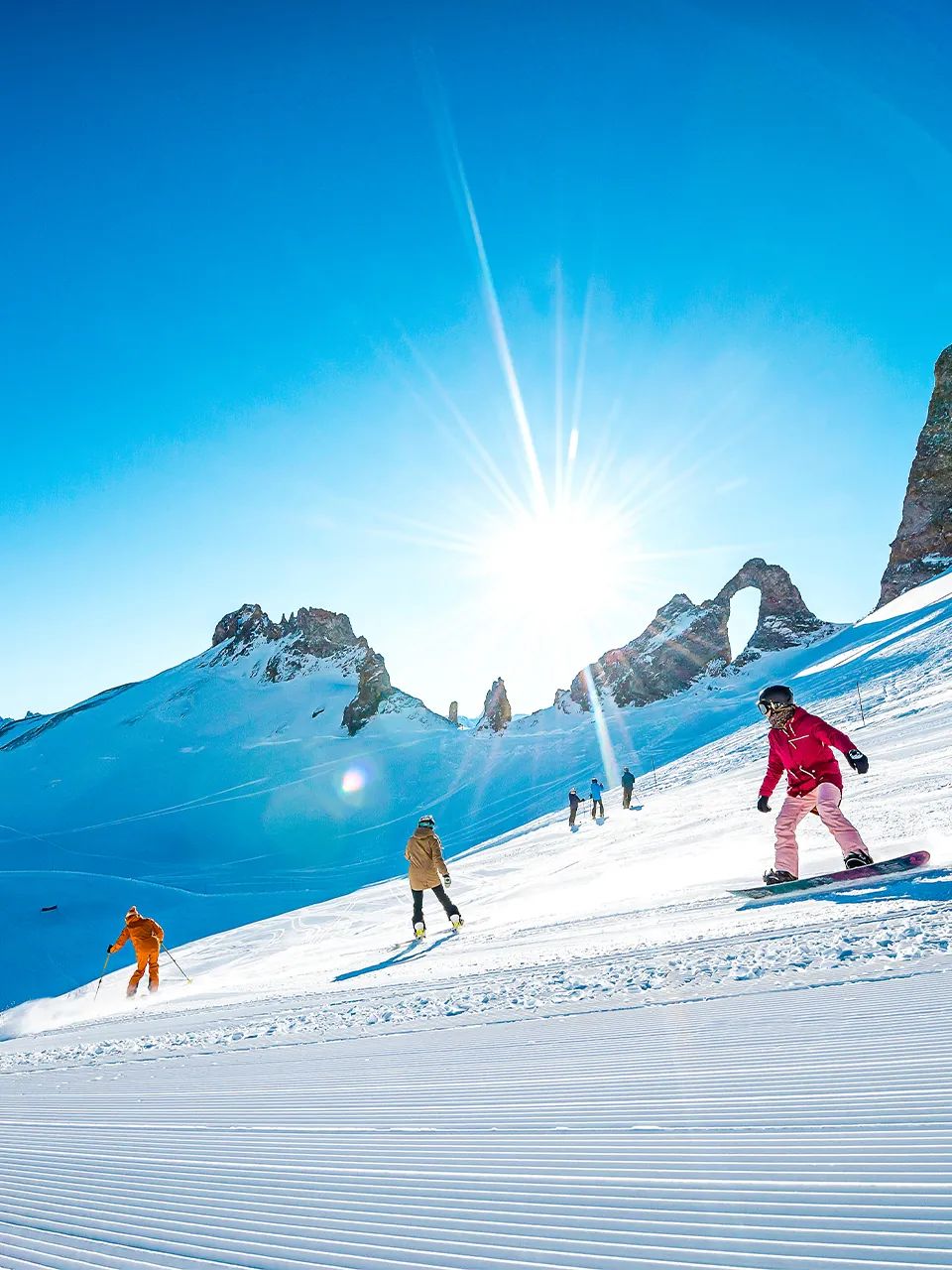
Intermediates have plenty to explore across both resorts. In Tignes, the Palafour and Tovière sectors have wide blue and red runs with long, steady pitches, ideal for building confidence and speed. For a longer journey, a blue trail runs all the way down from the Aiguille Percée (a rocky peak named after the natural arch near its summit). Up on the Grande Motte glacier, you’ll find the Génépy, which is a long, undulating blue with wide, gentle rolls and big views across the Vanoise National Park. The snow at that altitude usually stays in good condition well into spring.
Val d'Isère has just as much to enjoy. Solaise is sunny and rolling, with blues and reds that are easy to string together, while Bellevarde has long, open runs and great snow. Confident intermediates can also try the OK, the World Cup downhill course from the top of Bellevarde down to the entrance of the resort. For a change of scenery, the runs around the Col de l'Iseran are high and open, leading down towards the far end of the valley.
If you have time, skiing from one resort to the other makes a great day out. From the entrance to Val d'Isère, easy pistes connect straight through to Tignes, so the crossing is well within reach for confident intermediates.
Tignes - Val d'Isère is one of the great advanced ski areas in Europe. Much of the terrain sits high above the treeline, where steep faces, long mogul fields, and big vertical drops give strong skiers and riders a proper workout from the first lift to the last. Both resorts also have natural snow runs, which are patrolled and secured against avalanches but never groomed, so they ski like off-piste without leaving the marked terrain.
Val d'Isère's steep skiing has a racing pedigree. The Face de Bellevarde, which hosted the Olympic men's downhill in 1992, plunges more than 900m straight back into the village, and the slopes around it hold some of the resort's toughest bumps. In Tignes, the challenge comes from length and altitude, with long, ungroomed descents that drop from high, open ridges all the way down to the forest above Les Brévières. The best known is La Sache, around 10km of moguls from top to bottom.
It's the off-piste, though, that has made this area famous amongst expert skiers. Lifts across both resorts give quick access to huge bowls, steep couloirs, and long descents into quiet side valleys. The slopes around Tignes' Aiguille Percée are a good place to start, while Bellevarde and the glaciers hold bigger, more committing routes. This is serious high-mountain terrain, so explore it with a local guide.
Snowboarders get the best of both worlds, with wide-open slopes made for carving and some of the most varied off-piste in the Alps. Above the treeline, the pistes are broad enough to lay down long, fast turns, and the glacier's smooth, high-altitude runs are a treat early and late in the season. After a fresh snowfall, riders head straight for the bowls and gullies on both sides. If you're just starting out on a board, the moving-carpet learning areas in both resorts are an easy place to find your balance.
Freestyle runs deep here too. Tignes once hosted the Winter X Games Europe, and that spirit lives on in its big snowpark at Val Claret, packed with jumps and rails to session, plus several boardercross courses for racing your friends. Over in Val d'Isère, a snowpark of its own means you're never far from a park lap, wherever you're staying.
Many visitors are happy to stay on one side of the area, where a single-resort pass covers plenty of skiing at a lower price. The Tignes pass covers around 150km of pistes, from the Tovière and Palafour sectors down to Les Boisses and Les Brévières, and includes the Grande Motte glacier. The Val d'Isère pass covers a similar 150km across Bellevarde, Solaise, and the slopes around the Col de l'Iseran. Either one is a good fit for beginners or anyone planning a more relaxed week.
If you'd like to ski both resorts, the full Tignes - Val d'Isère pass covers around 300km of pistes, including the Grande Motte glacier, with passes available from one day up to a full season.
Chambéry is the closest airport, around 140 to 155km from the resorts. Geneva and Lyon are about 210 to 245km away, and Turin, just across the Italian border, is around 270 to 285km. From any of them, you can book a shared or private transfer or hire a car, with the final stretch climbing up the Tarentaise valley.
If you'd rather arrive by train, Bourg-Saint-Maurice is the nearest station, around 25 to 30km from both resorts, with seasonal services from Paris and London. Regular buses run from the station up to Tignes and Val d'Isère during the season.
Once you've arrived, a car isn't essential. In Tignes, shuttle buses link the upper villages and a gondola connects Les Brévières, while ski buses run the length of Val d'Isère. The two resorts are linked on the mountain, so most skiers simply ski between them. If you're not skiing, buses and taxis cover the roughly 12km road journey between the two.
For the best snow, aim for January to mid-March, when conditions are usually at their peak. With most of the terrain above 2,000m and the Grande Motte glacier topping out at 3,456m, though, the area is one of the most reliable bets in the Alps all season long, from the full opening at the end of November right through to early May. Christmas, New Year, and the February school holidays are the busiest weeks, so if you can travel outside them, early December and the first half of March tend to be quieter on the slopes. Early December also brings the Critérium de la Première Neige, a World Cup race on the Face de Bellevarde that has been held here since 1955.
Few areas can match the late season in Tignes - Val d'Isère. April skiing is a real possibility, with spring snow and sunshine on the upper runs, and both resorts open their glaciers for a few weeks of summer skiing in June and July.
Yes. The two resorts are linked by lifts and pistes, and with the full area pass, it's easy to ski from one to the other and back in a day. From the entrance to Val d'Isère, easy pistes connect straight through to Tignes. Many visitors are happy to stay on one side, though, and save the crossing for a day when they want a change of scene.
If you're comfortable on blue runs, you can make the crossing, as easy pistes link the two resorts. Much of the terrain along the way is high and open above the treeline, so it's most enjoyable on a clear day. Confident intermediates will get the most out of it, with plenty of reds to explore on both sides.
Not necessarily. A Tignes or Val d'Isère pass covers around 150km of pistes each, which is plenty for a week, and the Tignes pass includes the Grande Motte glacier. Choose the full Tignes - Val d'Isère pass if you'd like to explore both resorts, with around 300km of pistes on a single ticket.
Both work well. Val d'Isère holds the Famille Plus label, with a children's village, dedicated activities for young skiers, and an excellent learning area on the Solaise plateau. Tignes suits families who want everything close by, with ski-in, ski-out accommodation and progression zones right in Val Claret, Le Lac, and Le Lavachet.
Yes. The Grande Motte glacier above Tignes rises to 3,456m and is reached by a funicular from Val Claret, adding long, high-altitude runs to the ski area. Both resorts also open their glaciers for a few weeks of summer skiing, usually in June and July, though dates depend on snow conditions each year.
In Tignes, the upper villages of Val Claret, Le Lac, and Le Lavachet are ski-in, ski-out, and in good snow, runs lead down to Les Brévières. In Val d'Isère, there are ski-in, ski-out residences at the foot of the slopes, and pistes from Bellevarde and Solaise lead back down into the village centre.
The villages sit high, with Tignes' main bases at around 2,100m and Val d'Isère at 1,850m, so some visitors feel a little breathless or tired at first. Taking your first day steadily, drinking plenty of water, and building up gradually usually helps. Most people feel at home within a day or two.
Yes. In Tignes, the frozen Lac de Tignes is the centre of winter life, with dog sledding across the ice and even ice diving beneath it, and Le Lagon has a pool, water slides, and a wellness area. Val d'Isère has guided snowshoeing, dog sledding, paragliding, and an aquatic centre, plus a lively village centre full of shops, cafés, and restaurants to explore.
The Three Valleys is larger, with more resorts linked across three valleys. Tignes - Val d'Isère is higher, with a glacier and one of the longest seasons in the Alps, and it's known for some of the best advanced and off-piste skiing in Europe. If snow reliability and big terrain are top of your list, it's a strong choice.
Start building your dream ski trip today with our one-stop ski shop - hundreds of resorts, unlimited combinations.


 4.9/5
I usually book flights, transfers, hotel, ski rental and lift passes myself but this year used WeSki for a trip to Morzine. It was so much easier. Everything worked perfectly - transfers arrived on time and there was plenty of feedback throughout the whole process giving you confidence the holiday would go smoothly.

A really useful service that is so much easier to use than other 'all-inclusive' sites. It nicely bridges the gap between a travel agent and booking the trip yourself online. I will use WeSki every time I go skiing from now on.
We booked a late minute skiing trip to Morzine through we ski. We looked at booking the trip ourselves but could get anywhere near the price quoted by we ski. The company was excellent and we had no problems at all from start to finish. I would definitely use them to book another weekend skiing trip.
Seamless experience from start to finish. I was spending ages trying to sort out a weekend break and managed to do it with we ski in minutes and for the same price as booking it all up yourself. Flight, transfer and accommodation was all as expected and faultless.

WeSki is a trading name operated by Wetrip Weski Ltd (BR021500). All the flights and flight-inclusive holidays on this website are financially protected by the ATOL scheme. When you pay you will be supplied with an ATOL Certificate. Please ask for it and check to ensure that everything you booked (flights, hotels and other services) is listed on it. Please see our booking conditions for further information or for more information about financial protection and the ATOL Certificate go to: www.caa.co.uk.
Package holidays that do not include travel by air are financially protected via ABTOT.
For the latest travel advice from the Foreign & Commonwealth Office visit www.gov.uk/foreign-travel-advice.